PE22-28: What the Preclinical Research Shows
PE22-28 is a spadin-derived TREK-1 research peptide. Overview of preclinical literature, chemistry, handling and EU status. Research use only.
Read article

Research Use Only. The information below is a summary of preclinical and laboratory literature provided strictly for in vitro and research purposes. It is not for human or veterinary use, and nothing here describes or implies any use, dose, or administration in people or animals.
Retatrutide is one of the most discussed research peptides in the metabolic category, and laboratories that stock it often ask a practical question before anything else: is it better handled as a lyophilized powder or as a ready made research solution? This overview compares the two supply formats from a purely laboratory and handling standpoint, and sets out where the compound sits in the published preclinical literature.
Retatrutide (also referenced in the literature by the development code LY3437943) is a synthetic single-chain peptide that has been characterized as a triple receptor agonist, meaning it interacts with three separate incretin and metabolic receptors: the glucagon-like peptide-1 (GLP-1) receptor, the glucose-dependent insulinotropic polypeptide (GIP) receptor, and the glucagon receptor. This triple-target profile is what distinguishes it from single-agonist and dual-agonist research peptides in the same family.
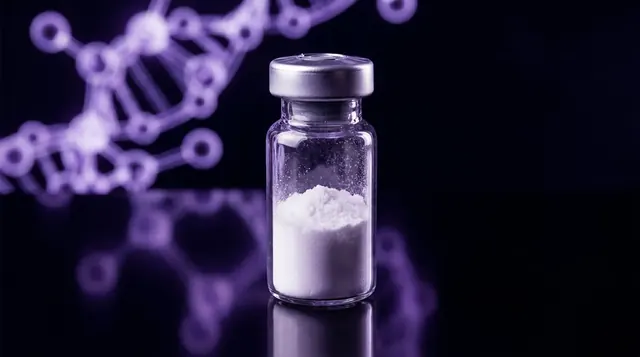
For research supply, the same molecule is offered in two physical formats. The powder format is a lyophilized (freeze-dried) solid sealed in a vial. The solution format is the peptide already dissolved and stabilized in a carrier at a stated concentration. The molecule itself is identical in both; what differs is the state it arrives in and how a laboratory prepares and stores it.
Retatrutide has been examined in third-party preclinical and mechanistic studies, primarily around its receptor pharmacology and its behaviour in animal and cell models. Reported areas of preclinical and scientific investigation described in the literature include:
These points describe published third-party laboratory and animal research only. They are not statements about effects in humans and are provided for scientific context.
Both formats contain the same peptide, so the choice is about laboratory workflow, stability priorities, and how a facility prefers to document and store its reference materials.
A freeze-dried powder is generally the more shelf-stable starting state, because removing water slows the chemical and physical processes that degrade peptides over time. It gives the laboratory full control over the final concentration and choice of reconstitution solvent, which matters when an experimental protocol calls for a specific buffer or vehicle. The trade-off is an added preparation step: the powder must be reconstituted accurately, and any weighing, solvent selection, and mixing introduces steps that need to be recorded for reproducibility.
A pre-made solution removes the reconstitution step, so the material is ready to aliquot at a known, labelled concentration. That consistency can be convenient where many samples are handled and inter-preparation variation should be minimized. The trade-offs are that a dissolved peptide is generally less stable over long periods than a dry solid, the concentration and carrier are fixed by the supplier rather than chosen by the lab, and solutions usually have tighter cold-chain and shelf-life expectations.
In short, powder favours long-term storage flexibility and protocol control, while solution favours convenience and preparation-to-preparation consistency. Many laboratories keep both on hand for different stages of a workflow.
Retatrutide is an investigational compound. It has not been approved as a medicine by the European Medicines Agency, the FDA, or other regulators, and it is supplied strictly as a research chemical for in vitro and laboratory investigation. In the EU, a research chemical keeps that status only while it is presented and handled as a laboratory reagent and not as a product for human or veterinary use. Presenting it with any health claim or use instruction would move it into medicines regulation, which is exactly why every Pure Chems listing and article keeps to preclinical, third-person, research-only framing.
Regulatory note: Retatrutide is an investigational agent that is not authorised for human or veterinary use in the EU or elsewhere. It is not a WADA-scheduled substance in the same way stimulants or classic anabolic agents are, but its investigational status means it must be handled only as a research material.
General laboratory handling principles for peptide reference materials apply to both formats. Lyophilized powder is typically kept cold and dry and protected from light until it is prepared, while a reconstituted or supplied solution is usually kept refrigerated and used within a shorter window. Freeze-thaw cycling is commonly minimized because repeated cycles can accelerate peptide degradation. As always, a laboratory should follow its own validated standard operating procedures and the specifications on the accompanying Certificate of Analysis. For solvent context, researchers often review guidance on bacteriostatic water for reconstitution and related solvent notes.
No. Retatrutide is an investigational compound that has not been approved by the EMA, FDA, or other regulators. It is offered only as a research chemical for laboratory use.
Retatrutide is supplied within the EU as a research chemical for in vitro and laboratory purposes, not as a medicine or consumer product. It must be purchased, stored, and handled strictly as a research reagent. Buyers are responsible for compliance with local and institutional rules governing research materials.
As a general rule for peptides, a lyophilized (dry) powder is more stable over longer periods than a peptide already in solution, because reducing water content slows degradation. A pre-made solution trades some of that long-term stability for preparation convenience.
No. The peptide is the same compound in both formats. The difference is only the physical state it is supplied in and how a laboratory prepares and stores it.
A Certificate of Analysis (COA) with identity and purity data is the standard reference document. It lets a laboratory verify the material and record it for reproducibility before any experimental work.
References sourced via PubMed.
Related reading on the Pure Chems research blog: Retatrutide: What the Research Shows, Retatrutide and Cagrilintide research combination, and GLP-3 RT research peptide. Research-grade material is listed on the Retatrutide powder and Retatrutide solution product pages.
Disclaimer: Research Use Only. All content above is provided for informational and scientific purposes and describes preclinical, in vitro, and laboratory literature only. Retatrutide is not a medicine and is not for human or veterinary use, consumption, or administration. Nothing here is medical advice or a health claim.
PE22-28 is a spadin-derived TREK-1 research peptide. Overview of preclinical literature, chemistry, handling and EU status. Research use only.
Read article
What bacteriostatic water is and how it is used as a solvent for reconstituting research peptides in the laboratory. Research use only.
Read article
A research-audience overview of ITPP, an allosteric effector of haemoglobin studied in laboratory oxygen-delivery models, including its regulatory status. Research use only.
Read article