Growth Hormone Secretagogues: A Research Overview
A research use only overview of growth hormone secretagogues: GHRPs, GHRH analogs and MK-677, their receptors and the preclinical literature.
Read article
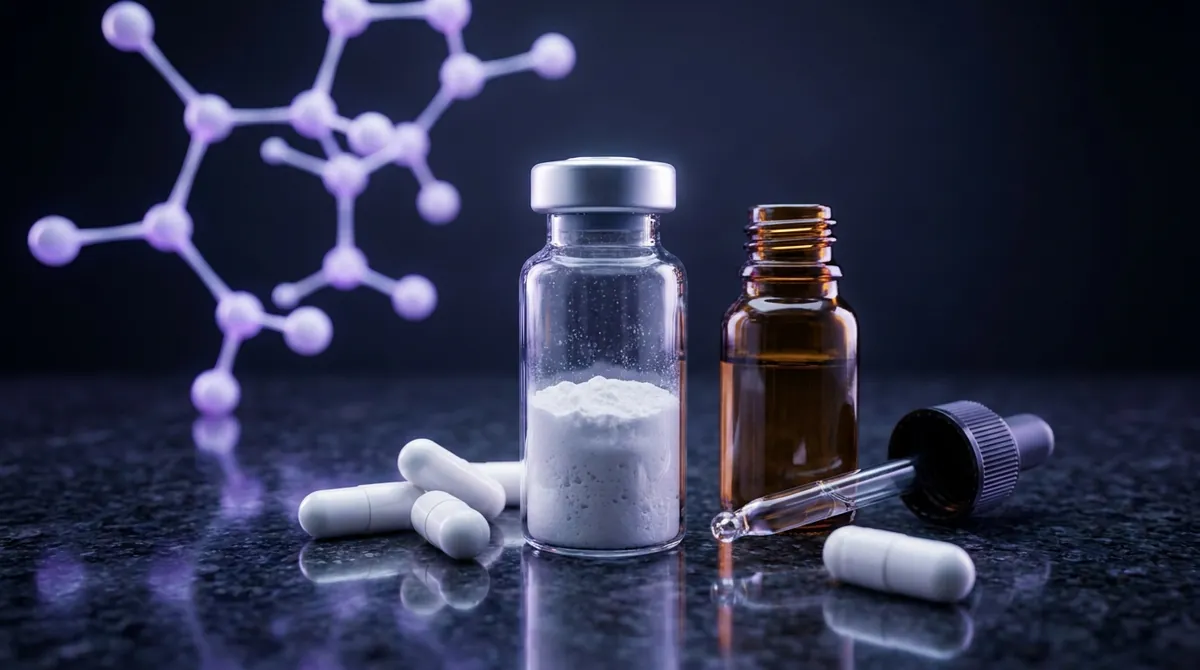
Research Use Only. The following is a technical comparison of two laboratory formats of 5-amino-1MQ intended for in vitro and preclinical research. It is not for human or veterinary use, and nothing here describes or implies any form of consumption, dosing, or administration.
Researchers sourcing 5-amino-1MQ for the bench often face a practical question before any experiment begins: should the material be handled as a reconstitutable solution or as pre-portioned capsules? The two formats contain the same small molecule, but they behave differently in a laboratory setting. This article compares the formats from a handling, stability, and study-design point of view, and points to where each fits in a research workflow.
5-amino-1MQ (5-amino-1-methylquinolinium) is a small-molecule quinolinium compound studied in the scientific literature as an inhibitor of the enzyme nicotinamide N-methyltransferase, usually abbreviated NNMT. NNMT sits at a metabolic junction: it uses the universal methyl donor S-adenosyl-L-methionine to methylate nicotinamide, a reaction that both consumes methyl groups and influences the salvage pathway that regenerates nicotinamide adenine dinucleotide (NAD+). Because of this position, NNMT has become a target of interest in metabolic and epigenetic research, and 5-amino-1MQ is one of the tool compounds used to probe what happens when the enzyme is inhibited.
Regardless of physical format, the compound itself is identical. The distinction this article addresses is purely about the vehicle a laboratory receives it in and how that vehicle affects preparation, measurement, and storage.
Interest in 5-amino-1MQ follows from a broader body of preclinical work on NNMT as a metabolic regulator. Studies in cell and animal models, described in third person below, have examined the enzyme and its inhibition across several tissue contexts.
These are descriptions of laboratory literature only. They do not indicate any established outcome in humans and are not offered as evidence of any benefit.
A solution format supplies the compound already in, or ready to be brought into, a liquid vehicle. For a laboratory the appeal is precision: once a known concentration is established, researchers can draw defined volumes for serial dilutions, plate-based assays, or analytical work without an intermediate weighing step. Liquid handling with calibrated pipettes tends to give tighter volume reproducibility than manual weighing of small solid amounts. The trade-off is that a solution is a more dynamic system. Concentration can drift if solvent evaporates, and the material is committed to whatever vehicle it sits in, so compatibility with the intended assay buffer should be checked in advance.
Capsules supply the compound as a pre-portioned solid. The main practical advantage is that each unit contains a nominal fixed quantity, which simplifies inventory and makes it easy to reconstitute one discrete amount at a time rather than working from a bulk powder. Capsules also keep the solid dry and separated from a solvent until the moment a researcher chooses to prepare a working stock. The trade-off is an added preparation step: the contents must be transferred and dissolved in a chosen solvent before any quantitative work, and the capsule shell itself is not part of the experiment and is removed during preparation.
5-amino-1MQ is supplied strictly as a research chemical. In the European Union, compounds like this are handled as laboratory reagents under chemical regulations, not as medicines. That classification depends on the material being described and used only in a research context. As soon as a product is presented with a therapeutic claim or framed for human or veterinary use, it would fall under medicines law instead. This is why every description here stays with preclinical, in vitro, and animal-model literature and avoids any suggestion of human use.
Regulatory and status note: 5-amino-1MQ is an investigational research compound. It is not an approved medicine or food supplement in the EU or elsewhere, and it has no authorised human or veterinary use. It should be handled only by qualified personnel in an appropriate laboratory setting.
Neither is universally better. A solution favours precise, calibrated volume work; capsules favour discrete pre-portioned handling and dry storage until use. The choice depends on the experimental workflow.
No. It is an investigational research compound with no marketing authorisation as a medicine or supplement in the EU or elsewhere. It is intended only for laboratory research.
It can generally be supplied within the EU as a research chemical for in vitro and preclinical laboratory use, provided it is sold and used strictly on a research-use-only basis and not presented for human or veterinary use. Purchasers are responsible for compliance with local rules governing research reagents in their own jurisdiction.
No. The molecule in a capsule is chemically the same as the molecule in a solution. Only the vehicle and the preparation steps differ.
Preclinical literature describes it as an inhibitor of nicotinamide N-methyltransferase (NNMT), an enzyme involved in methylation metabolism and NAD+ handling. This is a mechanistic description from laboratory studies, not a statement of any effect in humans.
References sourced via PubMed.
Related reading on Pure Chems: 5-Amino-1MQ: What the Research Shows, NAD+: What the Research Shows, and a comparable format comparison in BPC-157 Capsules vs Powder and Retatrutide Solution vs Powder. Products: 5-amino-1MQ solution (50mg) and 5-amino-1MQ capsules (50mg x 30).
Disclaimer: This content is for informational and research purposes only. 5-amino-1MQ is sold and described as a research chemical for laboratory use only. It is not for human or veterinary use, not a medicine or supplement, and no therapeutic or health claims are made. Always follow applicable laws and institutional safety requirements.
A research use only overview of growth hormone secretagogues: GHRPs, GHRH analogs and MK-677, their receptors and the preclinical literature.
Read article
Compare retatrutide research powder vs solution: stability, lab handling, and where the triple agonist sits in preclinical literature. Research use only.
Read article
PE22-28 is a spadin-derived TREK-1 research peptide. Overview of preclinical literature, chemistry, handling and EU status. Research use only.
Read article